





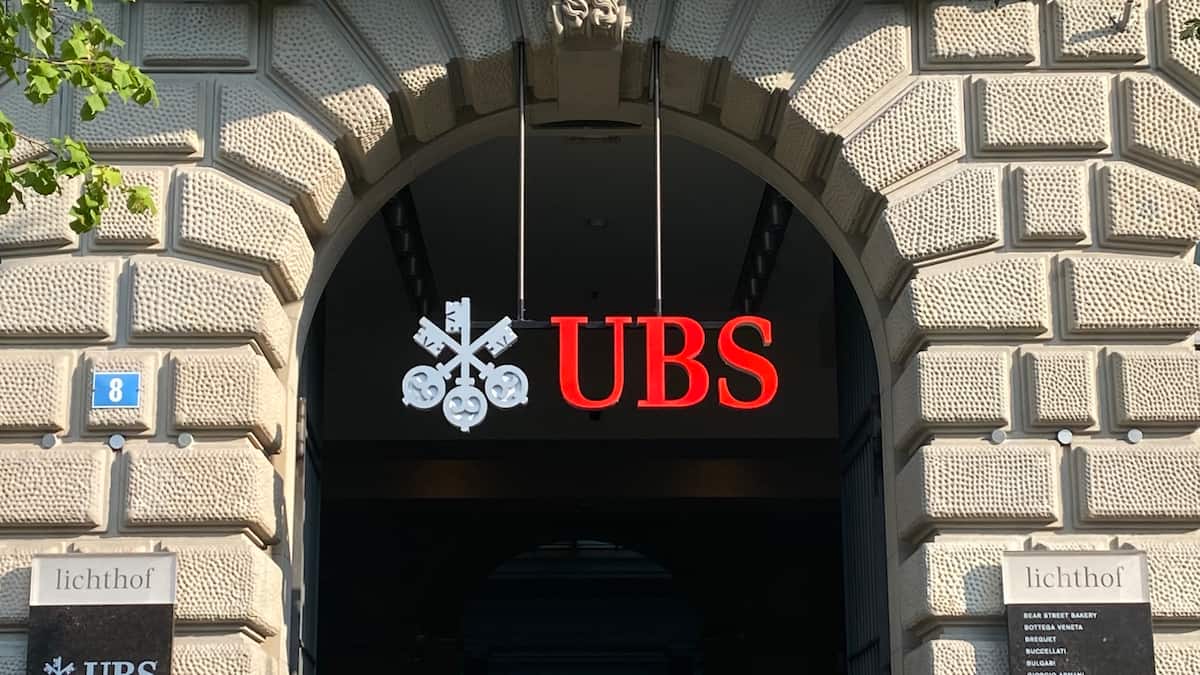
Three years after acquiring Credit Suisse amid market turmoil, UBS has exceeded integration targets, with annual cost savings of $13 billion and strong client inflows. Net new money reached $70 billion in the first half of 2026 alone, following $100 billion in 2024 and $130 billion in 2025, reversing initial outflows of about $100 billion after the deal announcement.
The bank’s cost base, relative to the combined 2022 baseline, has been reduced by roughly $13 billion annually through branch closures, staff reductions, and IT consolidation. With integration nearing completion, UBS expects a 20% jump in net profit for 2026, rising from 7.6 billion to 9.5 billion Swiss francs. The bank’s return on tangible equity is targeted to climb from 15% to 18% by 2028, which could push annual net income to about 13 billion francs, or 4.50 francs per share.
At such levels, UBS would trade on a forward price-to-earnings multiple of around 9 to 10, positioning it at a discount to peers and suggesting potential upside of roughly 50% toward 65 francs over the next two years.
Technical momentum has also supported the stock. After bouncing off the upper boundary of its 2023 uptrend, UBS now tests resistance levels last seen in 1998 and 2005. A sustained break above this zone could unlock an additional 10% to 20% gain in the near term.
Risk-seeking investors are turning to leveraged products to capitalize on the momentum. A call option with 6x leverage (ISIN: CH1572885619) could gain over 50% if UBS reaches 50 francs. An 8x-leveraged certificate (ISIN: CH1582370321) could rise about 80%, while a 10x call (ISIN: CH1592321918) would double in value. Gains of 100% to 200% are possible if the stock advances to 55 francs.
The products referenced are for illustrative purposes only and do not constitute investment advice or a solicitation to buy or sell financial instruments.





