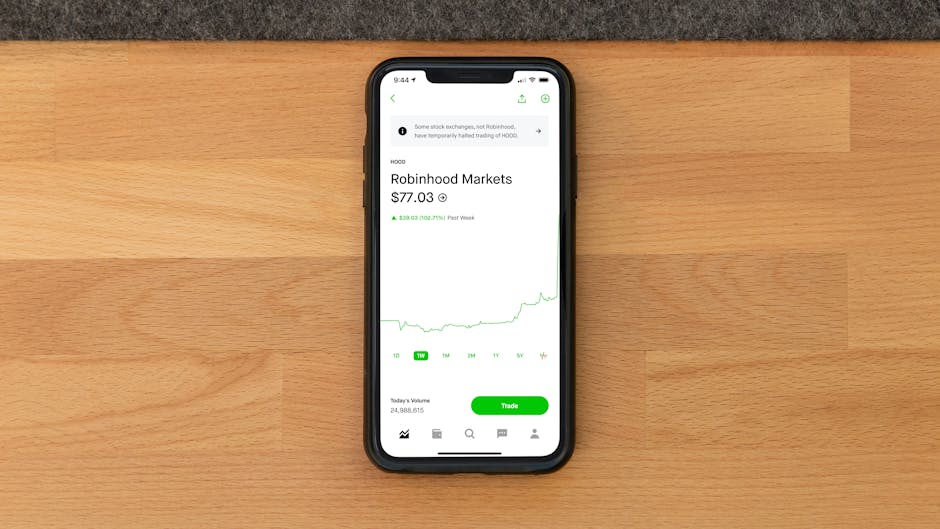
Robinhood Holdings (HOOD) presented at the Goldman Sachs Communacopia + Technology Conference on Wednesday, September 9, 2026, laying out its expanding footprint across retail banking, crypto-adjacent yield products and a new government-backed savings initiative for children.
CEO and co-founder Vlad Tenev said if he had to sum up the company in one word, it was "ownership." Robinhood has more than 28 million funded accounts in the U.S. and serves customers across more than 120 countries outside the U.S. The company reported annualized recurring revenue of $1.3 billion, trailing-12-month revenue of $4.93 billion—a 38% year-over-year increase—and gross profit margin nearing 92%. Earnings per share over the same period came in at $2.26, with a market capitalization of $103.7 billion and a P/E ratio of 51.4. Shares closed at $104.42 on Wednesday, down 5.46%, before recovering to $106.00 in after-hours trading.
Robinhood's product portfolio has broadened well beyond its original stock-trading app. The Robinhood Gold Card surpassed one million cardholders and offers 3% cash back across all categories, with rewards redeemable only into brokerage accounts. Robinhood Banking provides checking and savings accounts with interest rates above 3%. Through its Robinhood Gold IRA, the firm offers a 3% contribution match on annual deposits—a $1,000 deposit receives a $30 match. Robinhood Earn delivers 7% APY on stablecoins through Robinhood Chain, facilitated via USDG in partnership with Paxos.
The company also made a notable push into tokenized securities. More than 200 tokenized U.S. equities are available on-chain, and on certain days the tokens have generated billions in daily trading volume with peak daily gross revenue reaching $6 million. Tenev said two months ago at an event in London, Robinhood released the next version of its stock tokens into decentralized finance, allowing them to move beyond the Robinhood app in the EU and into DeFi pools and third-party smart contracts.
Perhaps the most consequential announcement was the Trump Accounts program, which targets roughly 70 million eligible U.S. children under age 18. Each child receives $1,000 in initial funding from the U.S. Department of the Treasury at birth. The consumer app launched in July, and donor funds—contributions from donors including Michael Dell—began flowing in recent weeks to accounts in Texas and nationwide. Robinhood serves as the sole initial broker and trustee alongside BNY Mellon, the Treasury and the IRS. Tenev called the program "ownership from birth" and said it was central to the company's mission.
Looking out over a 10-year horizon, Robinhood aims for 50% of its revenue to come from outside the U.S. and another 50% from institutional clients. The firm notes that over $100 trillion is projected to transfer from older to younger generations over the coming decades, a demographic shift Tenev sees as structurally favorable.
Tenev also touched on Robinhood's ambitions in AI-driven trading, saying the end goal is "giving active traders the power of a hedge fund in your pocket" through increasingly capable AI models paired with execution and safeguard rails.