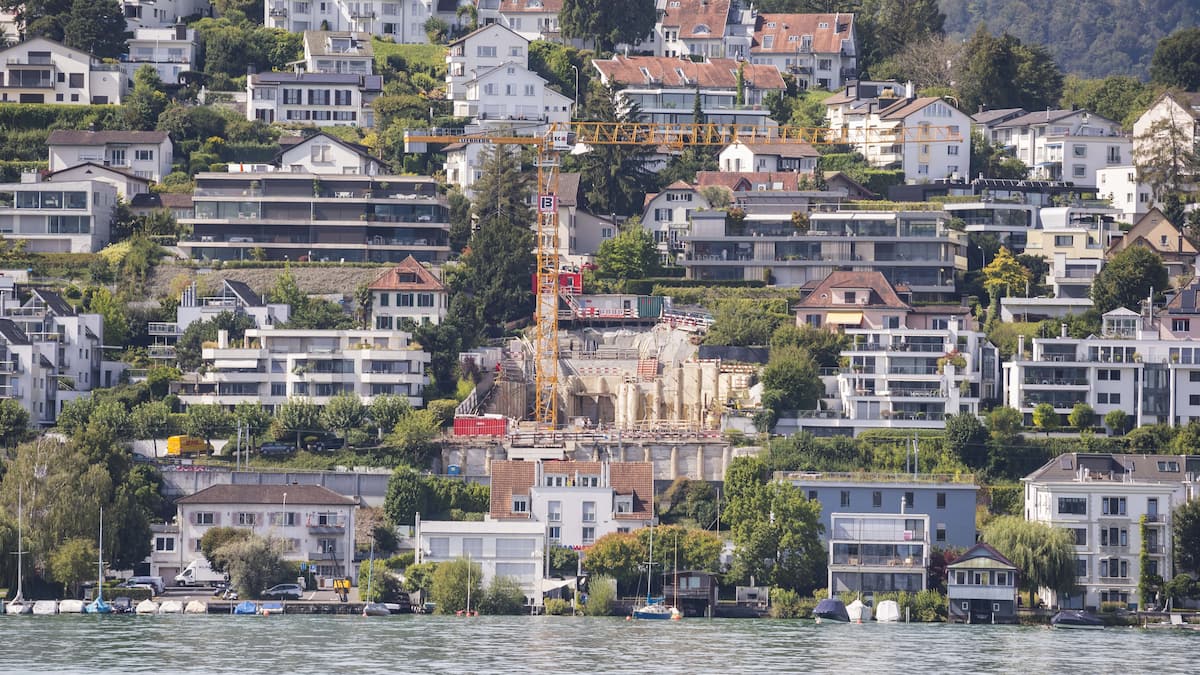
Prices on the once-less-expensive left shore of Lake Zurich have reached record levels, overtaking the region long regarded as the prime address. The so-called Goldküste — encompassing Küsnacht, Zollikon and Herrliberg — has held that status for decades, but developers are now building a wave of luxury homes along Kilchberg, Rüschlikon and Thalwil that rival it.
New buildings accounted for roughly 60 per cent of all single-family home transactions in the second quarter of 2026 along the left shore, according to data from Wüest Partner analysed by Engel & Völkers for the municipalities stretching from Kilchberg to Horgen. That represents an absolute record for the area, up from about 25 per cent three years ago.
"No other region within the canton of Zurich has such a high share of new-build homes," said Niki Thomet, 49, managing partner at Engel & Völkers, who has specialised in luxury property in the area for seven years. In all other parts of the canton, new-build shares in home transactions range between 30 and 50 per cent.
The construction boom is being driven largely by expatriates, many from Germany, drawn by the left shore's strong connections to Zurich, Zug and Schwyz via public transport and motorway — cities where high-skilled workers typically are employed.
New-build apartments carry an average premium of 5,000 Swiss francs per square metre over older stock, according to the broker. Average prices per square metre in Q2 were around 26,000 francs in Kilchberg, 24,500 francs in Thalwil, 24,000 francs in Rüschlikon and 18,000 francs in Horgen.
At the top of the market, the Lake Ville development in Thalwil set a new benchmark. An attic apartment there — 5.5 rooms and 186 square metres — sold recently for 6.28 million francs, equating to 33,000 francs per square metre, making it the most expensive home in the region to date.
Thomet noted that while new builds drive prices upward, older properties can still achieve strong results when the land itself holds value. "For detached houses and villas, the potential of a property is becoming increasingly important alongside its existing living space," he said.
Heatwaves and climate change were raised as possible factors shifting demand toward the left shore, but no causal link to prices has been established, according to Engel & Völkers.