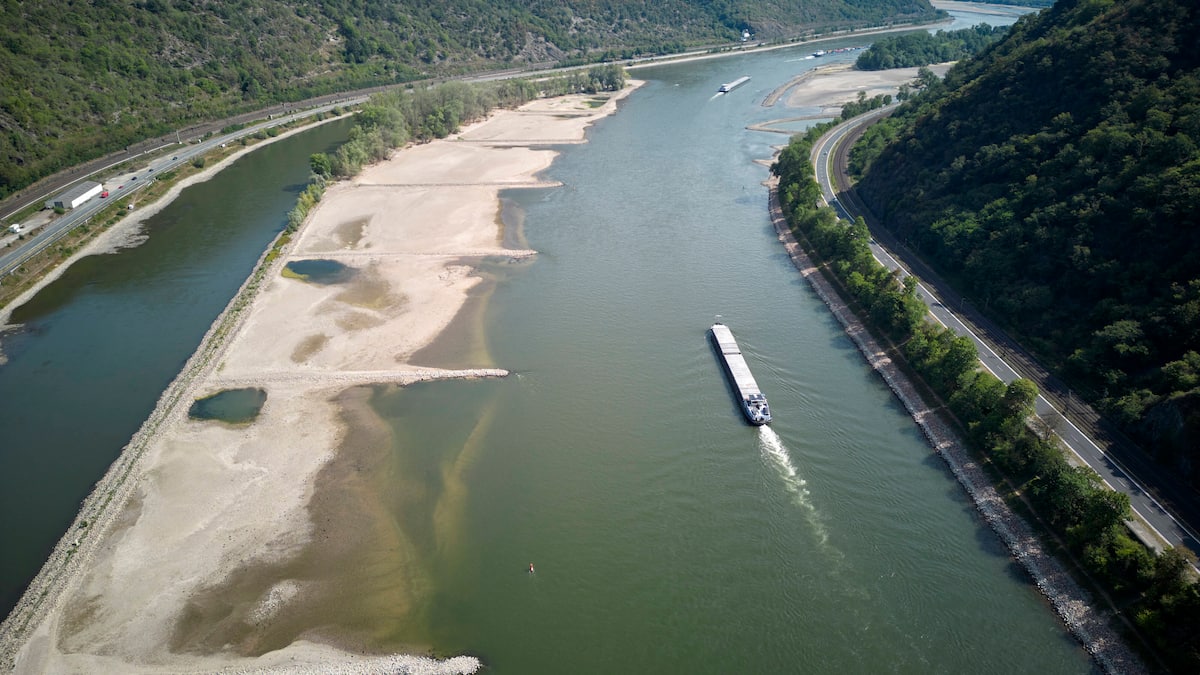
Barge traffic on the Rhine remains constrained despite recent rainfall that has lifted water levels, according to Germany’s Federal Waterways and Shipping Administration (WSV).
Operators are now able to carry more cargo than during the extreme low-water period in August, but vessels continue to operate at partial capacity. At the critical bottleneck near Kaub in Rhineland-Palatinate, the gauge stood at approximately 72 centimeters on Monday, up from 60 centimeters on Friday. Fully laden ships require a minimum depth of around 1.5 meters at this point.
The Rhine’s water levels plunged to a record low of under 10 centimeters in mid-August, surpassing the prior 2018 low of 25 centimeters. Actual navigable depth in the channel is roughly one meter above the gauge reading. Prolonged drought and multiple heatwaves this summer had drastically reduced water flow, forcing industries to absorb higher transport costs, logistics bottlenecks and production cuts. Cargo was either split across multiple vessels or rerouted to road and rail.
The Rhine serves as a key transport artery for grains, ores, coal and petroleum products. The WSV forecasts a slight decline in water levels over the coming week, though they are expected to remain well above the early August lows. A commodities trader noted that further relief will depend on precipitation levels in the days ahead.