





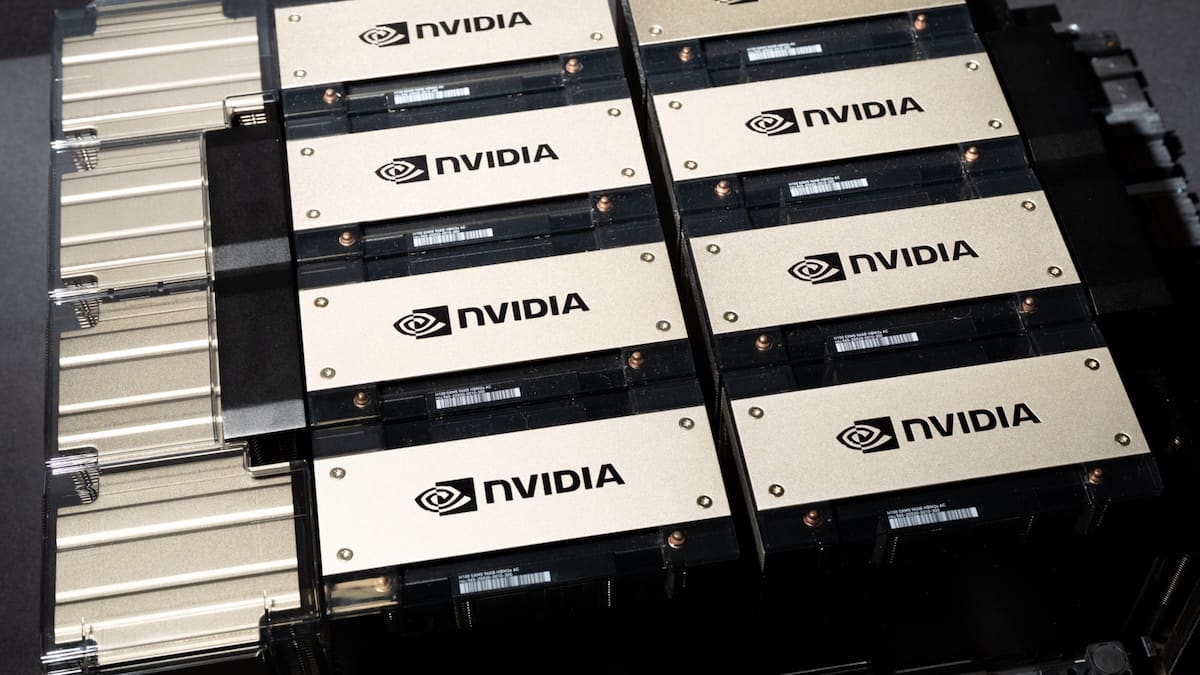
Nvidia’s dominance in AI chip supply is fueling record revenue growth, with Jefferies forecasting the company could achieve annual sales of $1 trillion by 2029. The projection follows a 108% year-over-year surge in quarterly revenue to $96.2 billion in the three months ended July 26, alongside a net profit of $59.7 billion.
The company’s outlook for the current quarter anticipates sales of $108 billion, plus or minus 2%, exceeding the midpoint of analyst estimates. Gross margins are projected at 74% for Q3, down slightly from 75% in the prior period. Nvidia’s market capitalization reached nearly $5.1 trillion on Wednesday, maintaining its position as the world’s most valuable company.
Jensen Huang, founder and CEO, emphasized the accelerating expansion of AI infrastructure, noting that production of the new Vera Rubin chip architecture is already running at high capacity. Vera Rubin, designed for agentic AI systems that autonomously plan and execute tasks, is expected to enhance efficiency in inference workloads while supporting higher performance demands than traditional training models.
Colette Kress, CFO, outlined a 70% revenue growth target for fiscal 2028, significantly outpacing the 45% average estimate from analysts. This trajectory would place Nvidia on track for roughly $700 billion in annual sales by fiscal 2028, according to Jefferies’ Blayne Curtis, who described the guidance as conservative. The firm’s 2029 revenue target of $1 trillion reflects expectations for sustained demand for AI infrastructure and higher revenue per gigawatt from Vera Rubin systems.
Competitive pressure is intensifying, with rivals including AMD, Intel, Broadcom, and Marvell developing alternative chips, while major customers such as Amazon, Microsoft, and Meta pursue custom inference solutions. Nvidia is expanding its portfolio to address adjacent markets, including autonomous driving and robotics, highlighted by the recent launch of the Orin Nano 2, an edge AI computing module designed for robotics and drones.
Speculation over strategic acquisitions has also intensified, with reports suggesting Nvidia is in advanced talks to acquire Hugging Face, a New York-based open-source AI platform, for over $13 billion. The deal, if completed, would position Nvidia at the center of the global AI development ecosystem.
Nvidia’s stock surged 7% in pre-market trading Thursday to $224.83, recovering ground lost after a sector-wide pullback in May. Analysts have responded with bullish revisions, with Bernstein’s Stacy Rasgon raising his price target to $400 and Goldman Sachs lifting its target to $300, both above the company’s prior record high of $236.
The company’s aggressive expansion strategy includes financial commitments to accelerate AI infrastructure buildouts. Reports indicate Nvidia is guaranteeing up to $120 billion in financing for OpenAI’s planned mega data center in Ohio, following earlier discussions of a $250 billion commitment. Additionally, Nvidia announced partnerships with Apollo, BlackRock, Blackstone, Brookfield, Goldman Sachs, and KKR to mobilize over $500 billion in capital for AI-focused funds, reducing reliance on manufacturer-led financing models criticized for circular funding structures.





