


Brent crude futures held above $91 per barrel on Tuesday, extending a three-day winning streak after briefly surpassing $91 for a third consecutive session. The contract last traded at $90.97, up 0.11% on the day, while September West Texas Intermediate rose 0.78% to $84.39.
Monday’s gains were concentrated in a single session. WTI surged 3.09% to $84.95 as markets priced in the expiration of the 60-day U.S.-Iran memorandum of understanding, which had been signed in June to provide a negotiating window. The agreement lapsed without replacement on Monday, removing a temporary de-escalation catalyst from the calendar.
Over the past month, Brent has gained 1.96% while WTI is up 2.99%. Year-to-date, Brent has advanced 38.27% and WTI 35.49%. The trailing three weeks have seen sharp volatility, with Brent retracing to roughly $80 on August 4 amid optimism over a draft U.S.-Iran agreement, only to rebound more than 7% between August 10 and 14. The recovery from the August 7 low of $78.08 on WTI to Tuesday’s print represents a 9.1% gain in seven sessions.
The 52-week range underscores the volatility. WTI has traded from an intraday low of $54.97 on December 17, 2025 to a high of $119.47 on March 9, 2026—a band of $64.50, or 76% of the current price. Tuesday’s $84.39 level sits 41.5% above the low and 29.4% below the high.
Money managers have reduced bullish positioning on both Brent and WTI over the past two weeks, leaving the rally without a speculative tailwind.
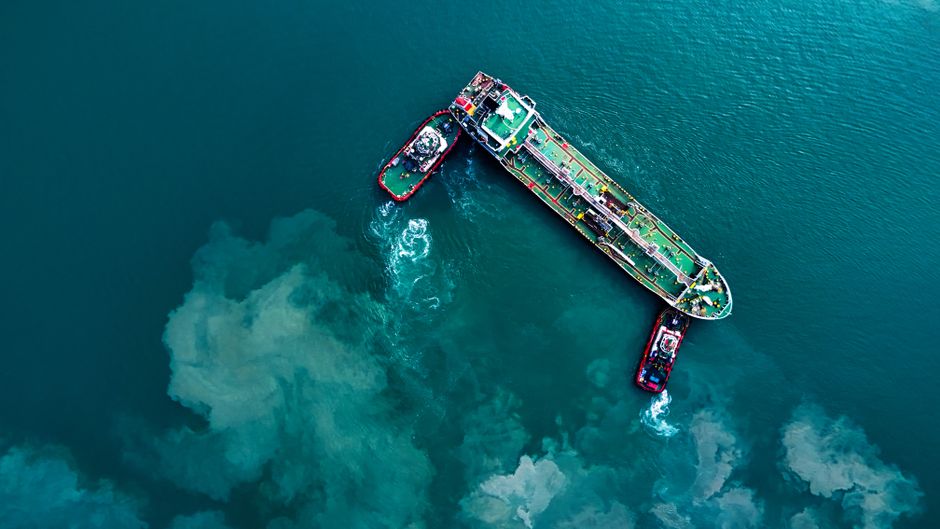
Physical supply data deteriorated sharply over the weekend. Only five commodity vessels transited the Strait of Hormuz on Saturday, with zero recorded on Sunday—a collapse of more than 90% from the 31 vessels that transited the prior weekend. The drop followed Thursday’s attack on two Abu Dhabi National Oil Company vessels, which removed the assumption of safe passage through the waterway.
Current flows out of the Strait are estimated at up to 5 million barrels per day, against a pre-conflict baseline of roughly 9 to 10 million barrels per day for the entire Middle East. The strait normally accounts for about a fifth of global seaborne crude. The reduction in throughput reflects rerouted cargoes, shut-ins, or halted shipments, with Iran continuing to target tankers that disregard its demands. The White House has signaled an indefinite naval blockade posture, raising insurance and freight costs for remaining transits without restoring volumes.
Alternative routing is expanding at the margins. Saudi crude is being diverted west across the country to Yanbu, adding distance and cost but bypassing the chokepoint. Libya and Egypt are reviving an 800-kilometer pipeline linking Tobruk to Alexandria, likely starting at 150,000 to 250,000 barrels per day. Such workarounds move hundreds of thousands of barrels daily, but the chokepoint handles millions.
Despite the transit collapse, the absence of a confirmed major supply outage has capped further gains, according to market pricing. The current judgment is that disruption is priced in, but catastrophe is not.
Diplomatic developments reinforced the risk premium. President Trump stated he would not extend the interim peace deal with Iran, which expired without replacement on Monday. He reiterated plans to impose new sanctions on Tehran and threatened to bomb Oman if it interferes with U.S. plans for the Strait of Hormuz—remarks aimed at the country mediating shipping talks from which Washington is excluded.
Iranian Foreign Minister Abbas Araqchi said Tehran has not decided whether to resume talks with the United States. A senior Iranian official separately warned that Iran would shift to a fully offensive military posture if diplomacy fails, escalating tensions in the strait. Israel launched fresh strikes on Lebanon over the weekend, killing 11 people including a senior Hezbollah commander, opening a second front in the regional risk calculus.
Trump urged Americans to accept higher gasoline prices during the conflict, removing a domestic political constraint that has historically capped how long administrations tolerate elevated crude prices. He is also considering another suspension of the Jones Act to ease coastal product logistics.
The pattern through 2026 has been consistent: every de-escalation headline has taken $8 to $10 off the barrel within days. The April ceasefire briefly dropped Brent, and early-August optimism over a draft agreement pushed prices to $80 on Brent and $78.08 on WTI before the rally reversed. That two-way sensitivity has thinned positioning, as money managers cut bullish bets on both benchmarks over the past fortnight.
The U.S. Strategic Petroleum Reserve stands at its lowest level since 1982, removing a key buffer that had functioned as an implicit ceiling on crude prices for four years. Coordinated strategic releases in 2022 demonstrated Washington’s willingness to deploy hundreds of millions of barrels to cap geopolitical spikes, a mechanism now largely unavailable at scale. Without it, supply disruptions must clear through the futures curve and demand destruction, with no buffer between a Hormuz shutdown and the price required to ration consumption.
The reserve’s depletion also constrains the policy response. An administration urging higher gasoline prices lacks the tool it would otherwise use, and a potential Jones Act suspension is a logistics workaround rather than a supply addition.
U.S. production growth offers no near-term offset. The Energy Information Administration expects domestic output to rise just 200,000 barrels per day in 2026. Shale producers in the Permian Basin are prioritizing cash returns over volume growth, a structural shift from prior cycles where $90 crude would have triggered an immediate rig response. The total U.S. oil and gas rig count rose modestly last week after holding flat the prior week, a pace inconsistent with a supply surge.



